


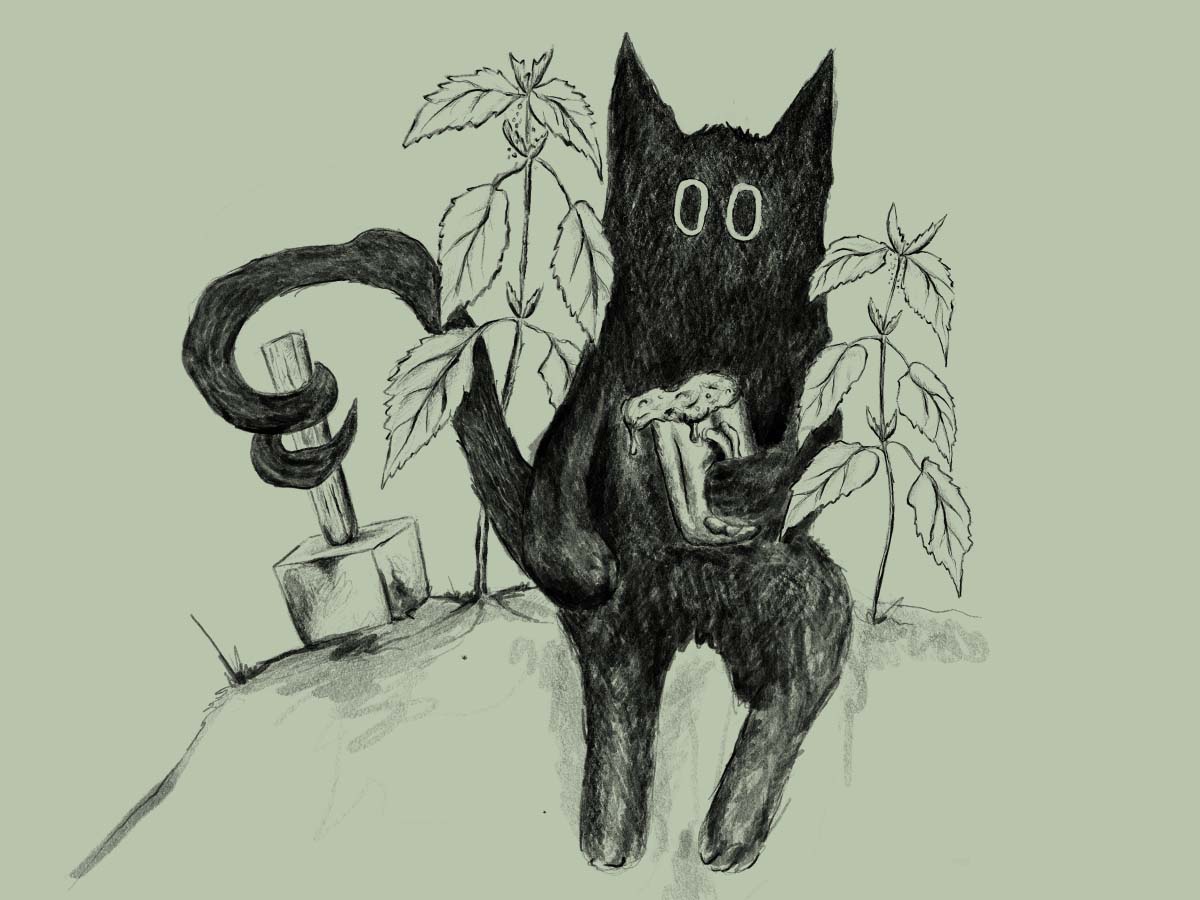
The Silent Cat Herbarium: Urtica dioica
Nettle - It Stings for a Reason
If you’ve been here before, you probably know this already: whatever keeps me going seems to have a soft spot for the outsider. The overlooked. The ones slightly off to the side. So it’s not really a coincidence - if that exists at all - that I ended up here. With the nettle.
A plant many people remove without much thought.
And yet, for quite a while now, I’ve had the feeling it’s the opposite. That some of the things we call weeds are here for a reason.
And lately, they seem to be making a quiet return. At least in certain circles. The kind I tend to trust a bit more.
So I started collecting fragments - from different authors, different traditions.
Not one explanation. Just layers.
Different ways of looking at the same plant.
Take from it what you want.
One of the first fragments comes from Sarah Robinson’s “Kitchen Witch - Food, Folklore & Fairy Tale.”

Nettle appears in some of the oldest surviving European healing traditions, including the Nine Herbs Charm, where it is named as one of nine plants used in protective healing preparations against poison and infection (mucgwyrt (mugwort), waybread (plantain), stune (watercress or Shepherd's Purse), stide (nettle), atterlothe (most commonly thought to be betony), maythen (camomile), wergulu (crab apple), fille and finule (chervil and fennel). In this tradition, healing is not limited to the body. As Robinson notes, charms and incantations are also understood to act on mind and spirit.
Nettle also appears in early spring traditions. Associated with the first wild greens after winter, it belongs to the moment when the world turns again toward growth. In some folklore, this season is linked to figures such as Brigid. Keeper of spring, fertility, and the return of green life.

In “Heilkräuter und Zauberpflanzen - zwischen Haustür und Gartentor” Wolf-Dieter Storl describes the nettle as a defensive, highly vital plant. One that reacts immediately to contact. Covered in fine, glass-like hairs, the nettle reacts instantly to touch. He adds, as Paracelsus puts it: Ubi malum, ibi remedium. The remedy is never far from the wound. Dock leaves tend to agree.
And yet, this defense is not seen as hostility, but necessity. As the Swiss herbalist Johann Künzle observed, without its sting, the nettle would likely have been eradicated long ago - so valuable are its qualities.
Storl also mentions that the nettle was part of a recipe called “Neunkräutersuppe” (Nine herbs soup) a spring preparation used to restore vitality after the cold months.
Iron, Blood, and Presence
Nettle is rich in iron, a mineral long associated with blood and vitality.
Storl expands this into a more symbolic dimension: Iron strengthens presence. It anchors awareness into the body.
He draws attention to a fascinating parallel:
Researchers have shown that the molecule of hemoglobin, the red pigment of human blood, is built upon a ring-shaped structure known as a porphyrin system. At its center sits an iron molecule. What is remarkable is not only its function, but its form. Because chlorophyll the green pigment of plants that captures sunlight and sustains almost all life on Earth, is built on the same fundamental molecular architecture.
A nearly identical porphyrin ring. But with one crucial difference:
- hemoglobin contains iron (Fe)
- chlorophyll contains magnesium (Mg)
Storl also associates nettle with Mars. Before modern botanical classification, plants were often interpreted through planetary forces like Mars, Venus, Saturn, the Sun. Here the nettle is associated with the force of Mars.
Its upright, defensive growth and stinging quality align with traditional associations of Mars. A force linked to heat, activation, and resistance.
The Awakening Through Contact
Not everyone experiences the nettle’s sting as purely unpleasant. Some describe a heightened sensitivity afterward, as if the body becomes more awake, more perceptive. In this view, the sting is not only defense, but activation.
A brief irritation that sharpens awareness.
A boundary that teaches the body where it begins.
A Plant of the Heart
He also mentions Rudolf Steiner, who once suggested that the nettle, in its essence, belongs near the human heart.
Not physically, but functionally.
Like the heart, it is:
• activating
• circulating
• vitalizing
It brings movement where there was stagnation.
It restores flow after stillness.

Thresholds and Unseen Presence
Indigenous peoples, as Storl mentions, notice strange appearances around nettle patches. Energies of ghosts, ancestors or brownies.
Transylvanian Romas talk about brownies called “Pchuvuschen” described as hairy, ugly and extremely horny. It is said, these brownies have 3 golden hairs on its head. If you are able to tear one out you will be able to transform stones to gold.
Whether or not one believes this… I would rather not test it.
The Plant of the Thunder God
Before modern botanical classification, the nettle was not only a medicinal plant but also a mythic one.
In Germanic tradition, nettle was associated with the god of thunder and storms. Known as Donar among the southern Germanic tribes, Thor among the Norse, and Thunar (Thunor) in Anglo-Saxon tradition.
This was no distant abstract deity, but a force of nature itself:
Thunder.
Lightning.
Fertile rain.
A being who travels across the sky in a chariot pulled by goats, striking down frost giants and clearing destructive forces from the land. And nobody can drink as much beer and mead as Donar. An apparently essential detail.
Here, the nettle appears not as a fragile herb, but as a plant of resistance and protection - aligned with the same force that defends the fields against chaos and cold. Even its traditional name in some regions reflects this association: Donnernessel (nettle of thunder)
Folk practices carried traces of this worldview. Brewers once placed nettle branches on brewing vessels during approaching storms, believing it could prevent spoilage or unwanted fermentation - as if the plant carried a stabilizing force against atmospheric disturbance.
Whether taken literally or symbolically, the nettle sits here in a clear archetypal field: a plant aligned with pressure, charge, and atmospheric transformation.

Culpeper also places nettle under the dominion of Mars. A planet associated with heat, action, and defense.
In his view, the nettle is not a passive plant.
It carries a warming and drying quality, making it especially suited to counter the cold and damp conditions left behind by winter.
Where the body becomes heavy, sluggish, or congested, nettle restores movement.
In his "Complete Herbal" he describes it as a plant that:
- clears phlegm from the lungs
- opens blocked passages
- stimulates natural flow in the body
- strengthens and cleanses the blood
Even externally, Culpeper notes its ability to:
- cleanse wounds
- restore damaged tissue
- revive cold and weakened limbs
Again and again, nettle appears as a remedy for what is stagnant, stuck, or excessive. Conditions that, in his system, arise from coldness and moisture accumulating in the body. It activates, pushes, and clears, sometimes through discomfort. Nettle does not simply soothe. It restores function by reintroducing movement, warmth, and circulation where they have been lost.
The Nettle as Everyday Medicine
In “Gesundheit aus der Apotheke Gottes”, Maria Treben describes the nettle as one of the most powerful healing plants available. So powerful, she suggests that if people truly understood its value, they would cultivate nothing else. For her, the nettle is a daily companion in healing.
She emphasizes that every part of the plant - root, stem, leaves, and flowers - carries medicinal strength, and places particular importance on its ability to:
- support the blood
- stimulate elimination
- restore energy and vitality
At the center of her view lies the idea of “blood purification”. An older concept describing the body’s effort to clear internal imbalance. While modern language may differ, the underlying observation remains: after winter, the body often feels heavy, tired, and sluggish. The nettle, taken as a tea, was traditionally used to bring movement back into the system.
Treben herself practiced seasonal nettle cures, taking the tea daily. Alongside internal use, she also highlights external applications:
- rinses for hair and scalp
- baths and compresses
- direct stimulation of the skin with fresh nettle
What stands out is not only the range of uses, but the attitude behind them: a quiet certainty that healing does not need to be complicated, only consistent.
Alongside this, she also describes how the plant is used in practice
Traditional Preparations of Nettle
Nettle Tea
A simple infusion made from the leaves, ideally fresh.
Pour hot water over about one heaped teaspoon per cup and let it steep briefly.
Traditionally taken over several weeks, especially in spring.
Nettle Root Tincture
The roots are harvested in spring or autumn, cleaned, chopped, and covered with alcohol. Left to infuse for about two weeks in a warm place, creating a concentrated extract.
Nettle Foot Bath
Roots and fresh plant material are soaked overnight in water, then heated the next day. The feet are bathed in the warm infusion for about 20 minutes.
The same preparation can be reheated and reused.
Hair Rinse
A strong decoction of nettle leaves or roots is used to rinse the scalp.
Traditionally believed to strengthen the hair and support the scalp.

These uses are rooted in traditional herbal knowledge, passed down through generations. Treben’s work reflects a time when herbal knowledge was still part of everyday life. Her writing carries a recurring sense that the most common plants are often the most essential.
So far, nettle has mostly entered my kitchen as tea and as food. Fresh leaves carry a deeper, greener taste than dried ones. In tea, it is often combined with other herbs such as peppermint.
Cooked nettle loses its sting and moves easily into soups, risottos, bread doughs, savory pastries, and other dishes usually associated with leafy greens. In this way, nettle does not remain at the edge of the meal, but becomes part of it.
The seeds can be added to salads or scattered over food, while tea, broth, and soup remain the forms I return to most often.
I often combine nettle with other “outsider plants” - and the pot, apparently, still needs stirring.
A plant of iron.
A plant of boundaries.
A plant that reminds us:
sometimes what stings
is what we need.

Books
- Nicholas Culpeper, Complete Herbal (ed. Steven Foster, 2019)
- Sarah Robinson, Kitchen Witch - Food, Folklore & Fairy Tale, 2022
- Wolf Dieter Storl, Heilkräuter und Zauberpflanzen, zwischen Haustür und Gartentor, 2018
- Maria Treben, Gesundheit aus der Apotheke Gottes, 2020






0 Comments